
Panels & wiring
Knob-and-tube wiring replacement
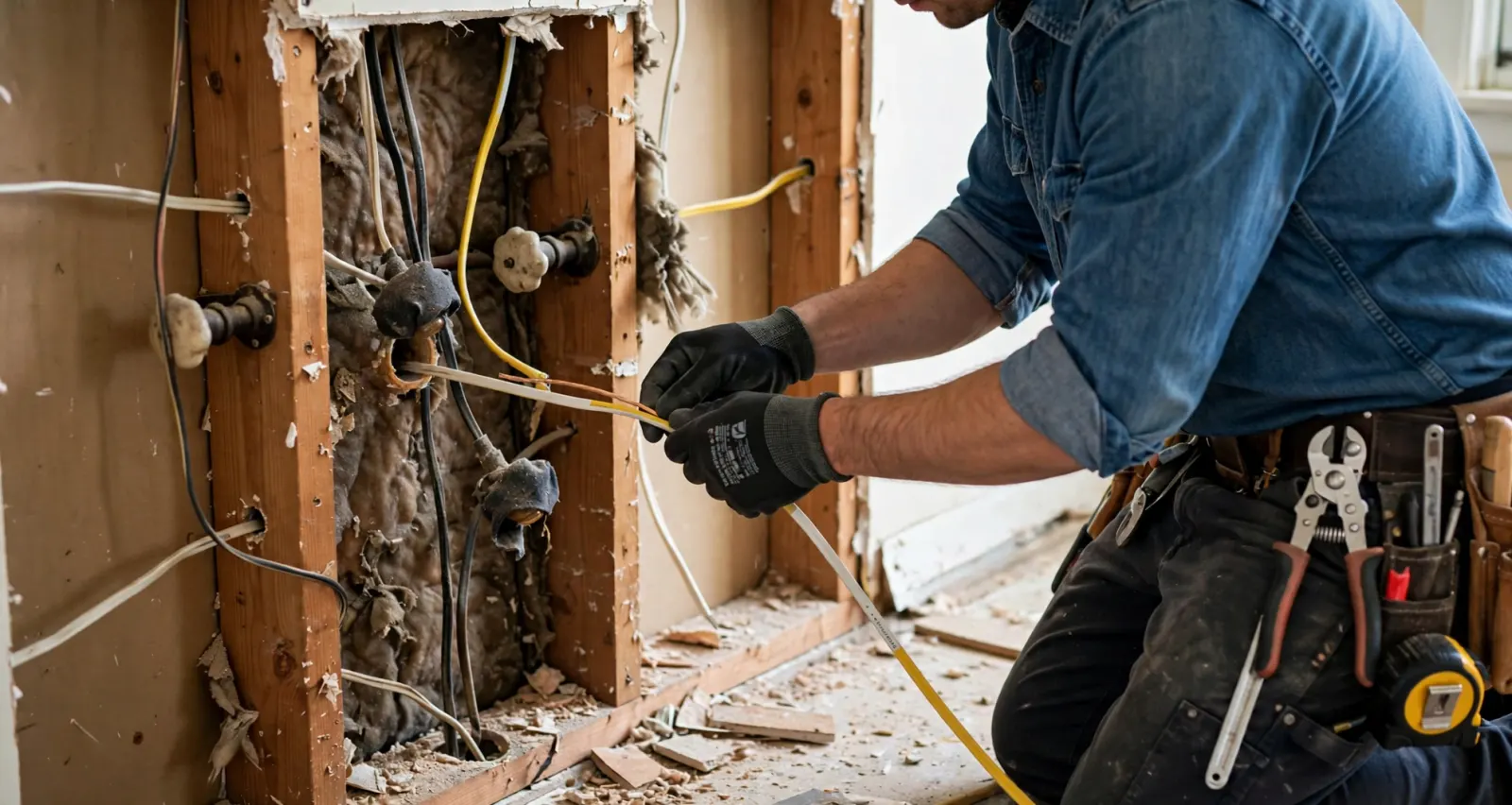
Knob-and-tube replacement removes early wiring (about 1880s to 1940s) that runs on ceramic knobs and tubes without a ground, and replaces it with modern grounded cable. It is commonly done before insulating, during renovations, or when an insurer requires it.
- Call now to check electrician availability in your area
- Licensed, independent electricians
- 47 states + DC
About knob-and-tube wiring replacement
Knob-and-tube wiring was designed to release heat into open air. Over a century, its insulation becomes brittle, connections are often modified by later owners, and it has no ground conductor for modern three-prong outlets or GFCI-friendly appliances.
The biggest practical issue is insulation: blowing insulation into walls or attics around active knob-and-tube traps heat, so many insulation programs and contractors require it to be assessed or replaced first. Insurers also frequently ask about it.
- Knob-and-Tube Wiring Replacement at a glance
- Panels & wiring
- Who does the work
- An independent licensed electrician
- Urgent calls
- Usually scheduled
- Typical first step
- Trace active circuits
Signs you need this
- Ceramic knobs and tubes visible in the attic or basement
- Two-prong outlets throughout the house
- An insulation contractor or energy program requiring an assessment
- An insurer asking about wiring type
- Fuses or a small service alongside old wiring
What the electrician does
- 1
Trace active circuits
The electrician identifies which knob-and-tube runs are still live and where they go.
- 2
Plan the routes
New cable routes are planned through attics, basements and walls to minimize openings.
- 3
Install new circuits
Grounded cable, boxes and devices are installed and the old wiring is disconnected.
- 4
Inspect and patch
Rough-in and final inspections are completed, and access holes are patched.
What affects the cost
Electricians set their own prices. These are the factors that move a quote up or down, so you can compare like for like.
- How much knob-and-tube is still active
- Plaster versus drywall walls
- Attic and basement access
- Number of floors
- Panel upgrade at the same time
- Wall patching and painting
What you can do safely, and when to stop
Safe to do
- ✓ Look in the attic or basement for ceramic knobs and photograph them
Stop and call
- ✕ Do not insulate over active knob-and-tube
- ✕ Do not splice new wire onto old
Knob-and-Tube Wiring Replacement FAQ
Is knob-and-tube wiring illegal?
Existing knob-and-tube is generally not illegal, but it cannot be extended, and many insurers and lenders treat it as a reason to replace.
Can knob-and-tube be insulated over?
It is not recommended, and many codes and insulation programs prohibit it, because the wiring relies on open air to cool.
How do I know if mine is still live?
An electrician can test it. Many homes have a mix of active and abandoned knob-and-tube.
How long does replacement take?
From a few days for a small home with good access to a few weeks for larger plaster-walled homes.
Do walls have to be opened?
Some small openings are usually needed, but most new cable is fished through walls from above and below.
Where electricians offer this
Local guides to knob-and-tube wiring replacement in cities where local housing makes it a common job:
Available through our network in 47 states and DC. Metro guides:
Related services
Home Rewiring
Rewiring replaces old branch-circuit wiring, such as knob-and-tube, ungrounded cloth-insulated cable or 1960s–70s aluminum branch wiring, with modern grounded copper cable.
Learn more →
Fuse Box Replacement
Fuse box replacement swaps an old screw-in or cartridge fuse panel for a modern circuit breaker panel, usually with a service upgrade at the same time.
Learn more →
Electrical Safety Inspection
An electrical safety inspection is a hands-on check of the panel, wiring, grounding, devices and protection by a licensed electrician.
Learn more →Need help with knob-and-tube wiring replacement?
Call now, or send a request and a licensed electrician who serves your ZIP code will contact you.